
What Do Data Centers Do and Why Do We Need Them?
You probably used a data center before breakfast this morning. When you checked your phone, opened your email, looked something up on Google, or loaded a news page – a data center was quietly sat behind it all, working away. Most people have no idea these buildings exist. They are not glamorous. They do not make to many headlines, although in 2026 are starting to.
Every digital service we depend on – banking, healthcare, communication, commerce, entertainment, booking flights, sending emails – runs through data center infrastructure. Remove data centers and the modern digital world we know today would not last long and shuts down.
This article explains what a data centre is, what it does, why we need them, and why they matter more today than at any point in history.
Key Points
- A data center is a physical building housing servers, data storage, power, and cooling systems that when fully commissioned and working, stores, processes, and delivers digital information across the world at speed from a click of a button or command.
- Every time you search Google, stream a video, send an email, or use an app – a data center made that happen.
- We need data centers because every piece of digital information has to live somewhere physical – and data centers are that somewhere. They are not really floating in the sky as ‘clouds’.
- Data centers run 24 hours a day, 7 days a week, no holidays or time off sick and with backup systems in place so they almost never go offline.
- There are several types: Enterprise, Colocation, Cloud/Hyperscale, and Edge data centers.
- The four core functions are: storing data, processing data, delivering data, and keeping it secure.
- They are not a “cloud”, as we are led to believe – they are actually large warehouses spread around the world in industrial parks.
- Goldman Sachs estimates data center power demand will grow 160% by 2030, driven almost entirely by AI.
Table of Contents
What Is a Data Center? [Simple Definition]
A data center is a building – sometimes multiple buildings – that houses the physical technology used to store, process, and send digital information.
Think of it like the kitchen behind a restaurant. You sit at the table, you order, the food is cooked then arrives, the experience is seamless. The kitchen is the data center, where everything is pulled together and the work happens.
Inside a data center, there are ‘data halls’ and in these halls you will find rows and rows of servers, essentially powerful computers, data storage systems, networking equipment, controls, air conditioning / cooling units, power infrastructure, and fire suppression systems. All of it works together to make sure data gets to where it needs to go, quickly, reliably, and that the hardware doing the work stays live and protected.
The short version: A data center is where the internet lives.
Why Do We Need Data Centers?
This is the question that sits behind most queries on this topic. The answer is pretty simple.
Every byte of digital information – every photo, message, transaction, document, video, search query, and AI response – has to exist somewhere physical. It cannot float. It cannot be virtual in the true sense of the word. It needs hardware: drives, processors, cables, and power.
Data centers exist because the scale of digital information [bytes] the world generates cannot be managed by individual computers. We need centralized, purpose-built facilities with the power, cooling, connectivity, and security to handle enormous volumes of data reliably, on demand, and safely.
We also need them because reliability matters. When your bank’s systems go offline, transactions fail. When an airline’s systems go down, flights are grounded and passengers are stranded. When a data center goes offline, you cannot even load this article. The redundancy and resilience built into them – backup power, backup cooling, backup connectivity, disaster recovery systems – is why critical digital services stay online even when things go wrong.
Consider the scale. A single large data center already draws as much electricity as a city of 100,000 people. [Goldman Sachs](https://www.goldmansachs.com/insights/articles/ai-to-drive-165-increase-in-data-center-power-demand-by-2030) estimates that AI will more than double that demand globally by 2030 – a total that would rival the entire electricity consumption of the European Union. [JLL’s 2026 Global Data Centre Outlook](https://datacentremagazine.com/news/data-centre-capacity-to-hit-200gw-by-2030-as-ai-demand-grows) projects total global capacity will reach 200 gigawatts by 2030 – nearly double today’s 103 gigawatts.
This is the question that sits behind almost every query on the modern internet. The answer is grounded in a hard truth: “The Cloud” is not a place; it is a physical destination.
Every byte of digital information – every photo, message, transaction, document, video, and AI response, must exist somewhere tangible. It cannot float. It cannot be “virtual” in the true sense of the word. It requires physical hardware: silicon chips, spinning drives, miles of fiber-optic cabling on land and below the sea, and massive amounts of electricity.
We need centralized, purpose-built data centers for three primary reasons:
The Necessity of Scale
The sheer volume of data the world generates is now far beyond the capacity of individual computers or office server rooms. Data centers provide the industrial-scale “compute” required to process trillions of data points simultaneously. They are the engine rooms of our digital economy, managing workloads that would overload even a hardware setup from a few years ago.
The Need for Speed [Latency]
Data needs to be close to you. If you are in London and the data you need is only stored in New York, no matter how fast it travels, there will always be a delay [Latency]. We need a global network of data centers to minimize this delay and latency, ensuring a Netflix video starts instantly, a stock trade executes in milliseconds, and your general office job is not affected. We call it ‘Lag’
The Requirement for Reliability
In the digital age, “offline” is not an option. When an airline’s systems go down, flights are grounded; when a bank’s data center fails, global commerce halts, if a large Office software platform stops working that is a global affect. Data centers are built with a lot of redundancy. They will typically include backup power sources, industrial cooling systems, and disaster recovery protocols designed to keep critical services online even when the local power grid fails, water is cut off or hardware breaks.
The AI Shift: Why We Need Them More Than Ever Now
As our reliance on digital services grows, so does the physical cost. We are currently witnessing a historic surge in demand, driven largely by Artificial Intelligence. Unlike traditional data storage, AI requires “high-density compute” – processors for this type of work run hotter and consume significantly more power.
Consider the scale:
- Current Demand: A single large-scale data center can draw as much electricity as a city of 100,000 people.
- The AI Surge: Goldman Sachs estimates that AI will drive a 160% increase in data center power demand by 2030.
- The 2030 Outlook: JLL’s 2026 Global Data Centre Outlook projects that total global capacity will reach 200 gigawatts by 2030, roughly doubling today’s 103 gigawatts. To put that in perspective, 200GW is enough capacity to power roughly 150 million homes simultaneously.
Data centers are the invisible web of our modern lives. As we move further into the era of AI, these facilities will transition from being “tech infrastructure” to becoming the most critical—and energy-intensive—utilities on the planet.
What Do Data Centers Do?
A data centers role usually consists of four things:
It Stores Data
Every photo you upload, every document you save to the cloud [a warehouse in Slough], every transaction you make online – it gets stored somewhere physically. That “somewhere” is a data center.
The services most people use daily to store files – Google Drive, OneDrive, Dropbox, iCloud – all run on data center storage infrastructure. When you save a document or photo to any of them, it is stored on physical hardware inside a data center, not on your device. That storage happens on hard drives and solid-state drives housed inside servers and dedicated storage arrays. Data centers also run regular backups and maintain disaster recovery systems: copies of data held in separate locations so that if one facility fails, nothing is permanently lost.
The amount of data the world generates is staggering. IDC – projects global data will reach 660 zettabytes, 660 trillion gigabytes, 1.289 trillion 500GB iPhones by 2030. Data centers are the infrastructure managing all of it.
It Processes Data
Storing data is only half the job. Data also needs to be processed – calculations run, queries answered, algorithms executed, commands executed.
When you create a query on Google, an AI assistant a question, run a financial transaction, or stream a Netflix / Youtube show, servers inside a data center are doing the computational work in real time to serve you that information. Modern AI applications in particular are pushing processing demands to levels we have never seen before – and the infrastructure requirements are having to grow to match.
It Delivers Data
Processing data is worthless if it cannot get to you. Think about what happens when you load a page on your phone, laptop or smart TV from your sofa. A request leaves your device, travels through your home Wi-Fi router, out through your broadband connection – running on fiber networks owned by providers like AT&T, Comcast, or Verizon in the US, or BT, Virgin Media, or Sky in the UK – across hundreds of miles of over land cables or thousands of miles of undersea cables, into a data center, gets processed, and comes back to your screen. All of that, in under a second.

The networking equipment inside a data center – switches, routers, fiber connections – is where that journey ends and begins. It connects the servers to the fiber networks that ultimately reach your street, your building, and your router. Speed and reliability is the priority. No one wants to wait three minutes for a web page to load anymore.
4. It Keeps Data Secure
Data centers protect your information at two levels.
In actual physical form, they use fenced perimeters, security guards, biometric access controls, CCTV, man-trap entry systems that act as double-door airlocks that stopping un authorized access, and fire suppression systems designed to protect hardware and equipment.
Digitally, they serve firewalls, encryption, intrusion detection, and regular security audits.
The organizations that own the most sensitive data in the world – banks, hospitals, governments – are among the heaviest users of data center infrastructure [Amazon, Microsoft Azure, Google Cloud, Oracle]. With this in mind, security is paramount to their core function of the systems, engineered in from the start.
What Is Inside a Data Center?
A data center is the building – or campus of buildings – that houses all of the infrastructure. Not a single room, but a purpose-built facility divided into several distinct functional spaces, each with a specific role:
- Data halls: where the servers and storage equipment live. The primary working space of the facility.
- Electrical / Power plant rooms: housing UPS battery systems, switchgear and diesel generators.
- Mechanical / Cooling plant rooms: HVAC systems, chiller units, and cooling distribution infrastructure.
- Network rooms: where external fiber connections from carriers and internet providers terminate.
- Support spaces: security rooms, control rooms [NOC], engineering offices, staging rooms and loading bays.
- Common spaces and corridors: movement routes around the facility and the primary pathways for routing electrical, mechanical, and HVAC services throughout the building.
When people refer to what is “inside” a data center, they are almost always talking about the data halls. These are purpose-built, controlled environments – sometimes called server rooms or computer rooms in smaller facilities – each with its own dedicated power feeds, cooling infrastructure, and access controls, usually located in the central core of the building. A large data center may contain several data halls across multiple floors, each one packed with rack upon rack of servers and storage.
When we say its a ‘1 GW’ data center – it would not be all one data hall, it would be multiple halls ranging in differing loads [20MW to 80MW] depending on the design. For other smaller data centers halls can be as small as 500w, 1MW, 2MW.

Servers
Servers are the workhorses in the process. Unlike your laptop at home, a server has no screen and no keyboard. It is a slim, powerful machine built for one job: to stay on continuously and serve data to people anywhere in the world. When you click a link or open an app, you are sending a request to one of these machines.
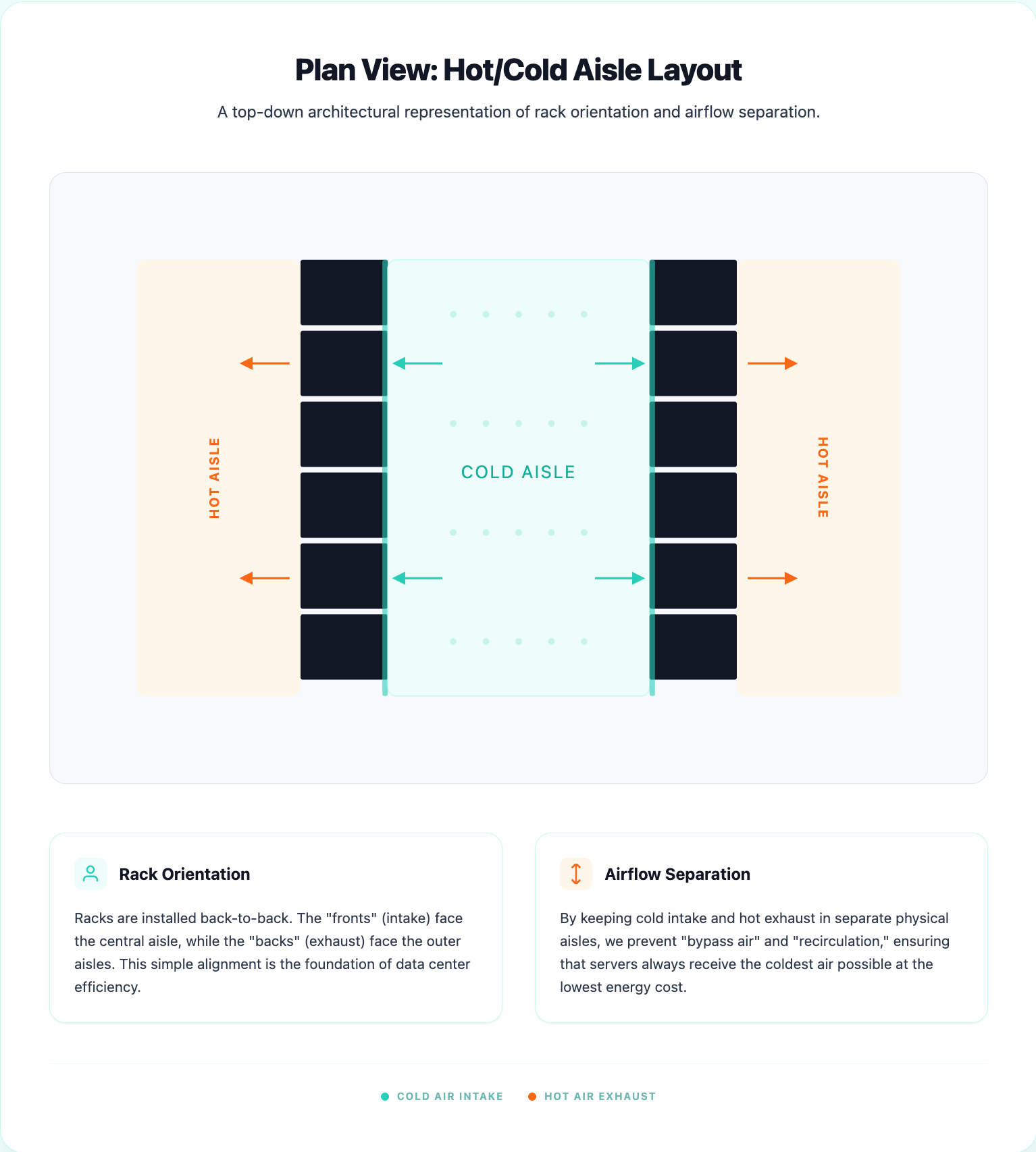
To maximize space and manage the heat they generate, servers are organized in a strict hierarchy. Individual servers slot into metal frames called racks, stacked one above the other. Those racks line up in long rows to form aisles – a layout designed deliberately to channel cool air, to allow cooling, in from one side and push hot air out of the other. The aisles sit inside data halls, the vast, warehouse-like rooms that form the primary working space of the facility.
A smaller number of servers sit in the network rooms, closer to the building’s fiber entry points, where they handle connectivity, routing, and the traffic flowing in and out. A large data center can house tens of thousands of servers across these spaces. Some modern hyperscale facilities house hundreds of thousands.
Networking Equipment
Switches, routers, and fiber optic cables connect the servers to each other and to the outside world. The networking layer determines how fast and reliably data can move.
Storage Systems
Separate from servers, storage arrays hold huge volumes of data – databases, backups, archives etc. Think of these as the filing cabinets, except they hold exabytes of information [one exabyte equals one billion gigabytes].
Physical Security Systems
Cameras, access control systems, biometric readers, man-traps, and on-site security personnel. Data centers take physical security seriously – and the most critical facilities treat it with the same focus as a government building.
Power Infrastructure
Servers never sleep. They need continuous, uninterrupted power, and data centers use multiple layers of power protection to ensure this:
- UPS (Uninterruptible Power Supply): a rectifier (converts AC to DC to charge batteries), batteries (store energy for backup), an inverter (converts DC back to AC for equipment), and a static bypass switch (transfers load to mains during failure) that kick in instantly if mains power fails protecting the facilitiy until the system has switched over or the generators are up to speed and have come on line.
- Backup generators: Diesel generators that run if the power during the outage does not switch over fully.
- Redundant power feeds: Multiple separate connections from different power supplies to the equipment, so no single failure brings everything down
Cooling Systems
Servers generate heat. Lots of it. Left unconditioned, that heat will destroy the hardware fast.
Cooling the data halls is one of the biggest challenges in any data center. The cooling equipment – HVAC [heating, ventilation, and air conditioning] systems, raised-floor airflow management units, fan walls and liquid cooling – is designed to handle everything the servers generate. Getting it right is critical. Getting it wrong could cook the facility, shutting it down.
The recent AI has changed the required cooling loads dramatically. In 2015, a standard server rack drew between 5 and 7 kW of power. Today, a rack of AI Nvidia GPUs demands 40 to 100 kW, with some configurations exceeding 120 kW. That is a 15 to 20x increase in heat generation from the same floor space. The underfloor / air cooled designs do not work in these instances.
Liquid cooling is now becoming the industry’s answer to the high density chip designs: chilled water or specialized fluids circulated directly through the server racks, allow the heat to be pulled out at the source. For AI infrastructure, it is rapidly becoming the standard. The question the industry is still working through is how to retrofit existing facilities that were never designed for these load densities.
Fire Suppression Systems
Data centers use specialist fire suppression systems – typically clean agent gas or pre-action systems, rather than water sprinklers in the data halls. These systems are designed to extinguish fires without damaging the hardware or keeping any damage to a minimum.
What Are the Different Types of Data Centers?
Not all data centers are the same, and there are four main types, each serving a different purpose.
Enterprise Data Centers
An enterprise data center is owned and operated by a single organization for its own use. A large bank, a hospital system, or a government agency might run its own data center on-site or nearby.
The advantage is control. The organization owns the hardware, manages the security, and sets the rules. The downside is cost – building and running your own data center is expensive, and it is a full-time operational commitment.
Colocation Data Centers
Colocation facilities – often called ‘colo’ – rent out data hall and rack space to multiple organizations in the same spaces and data hall. You bring your own servers and networking equipment. The data center provides the building, power, cooling, physical security and connection to the outside world.
Think of it like renting a desk in a serviced office rather than building your own building. It gives organizations access to enterprise-grade facilities without the capital cost. Major providers like Equinix and Digital Realty operate global colocation networks.
Cloud and Hyperscale Data Centers
These are the giants. Companies like Amazon Web Services, Microsoft Azure, Google Cloud, Alibaba, and Tencent operate hyperscale data centers – massive facilities, sometimes spanning hundreds of thousands of square metres, that power their cloud platforms.
Cloud computing runs on the back of these facilities. When businesses talk about “moving to the cloud,” they are generally moving their workloads into them – accessing computing as a service [Infrastructure as a Service, or IaaS], software as a service [SaaS], or platform services [PaaS] – rather than running their own hardware.
Edge Data Centers
Edge data centers are smaller facilities positioned closer to end users, in cities and towns rather than in remote locations.
The reason is latency, the delay between sending and receiving data. Some applications need responses in milliseconds – autonomous vehicles, real-time gaming, remote surgery. Getting servers physically closer to users cuts that delay significantly. Edge computing is growing fast as more of our infrastructure requires near-instant response times.
How Reliable Are Data Centers?
Not all data centers offer the same level of reliability. The Uptime Institute, one of the independent bodies that set global data center standards, defines four Tier classifications, each representing a different standard of redundancy and availability:
‘Uptime’ is the percentage of time a facility is fully available – out of 8,760 hours in a year [365 days x 24 hours]. Annual downtime is the maximum number of hours each Tier rating permits a facility to be unavailable within that same period.
| Tier | Classification | Uptime | Annual Downtime |
|---|---|---|---|
| Tier I | Basic infrastructure | 99.671% | ~28.8 hours [0.329%] |
| Tier II | Redundant capacity components | 99.749% | ~22 hours [0.251%] |
| Tier III | Concurrently maintainable | 99.982% | ~1.6 hours [0.018%] |
| Tier IV | Fault tolerant | 99.995% | ~26 minutes [0.005%] |
Tier I is a basic facility with limited redundancy. Tier IV is fully fault-tolerant: no single failure in power, cooling, or networking can cause an outage. Banks, hospitals, and government agencies typically require Tier III or Tier IV. The higher the tier, the more resilient the infrastructure – and the higher the $$$ cost to build and operate it.
Most people will never experience a data center outage affecting a service they use, because the operators design, build and commission their facilities specifically to prevent it.
Multiple independent power feeds, instant battery backup, diesel generators capable of running for days, on-site water storage reserves to keep cooling towers running continuously without interruption – a huge the layered protection system is in place.
Good data centers do not go offline. The ones that do tend not to be the ones running services you rely on.

A Few Things to Know
Who actually owns all of this?
Ownership is more varied than most people assume. Technology giants – Amazon, Microsoft, Google, Alibaba, Tencent and Meta – own enormous global portfolios to power their own platforms and serve their customers. Specialist colocation providers like NTT, Airtrunk, Vantage, Equinix and Digital Realty own facilities and rent space to businesses.
Individual organizations run their own enterprise data centers for internal use. And increasingly, institutional investors and real estate funds treat data center infrastructure as a long-term asset class – the same way they might invest in airports, hospitals, utility companies or toll roads.
What happens when something goes wrong?
If a data center fails, servers go offline adn there is no backup: applications stop, data becomes inaccessible, every service depending on that facility goes offline. Cooling also stops – and this is the less obvious threat. Without active airflow or liquid cooling, temperatures inside data halls rise fast. Server hardware can sustain permanent damage within minutes. Fire suppression and monitoring systems, which depend on powered sensors and detection infrastructure, are also compromised.
This is exactly what the layered protection architecture and design prevents.
What about the environmental and community side?
This is a conversation the industry can no longer avoid, data centers have become news worthy. Data centers consume significant electricity and water – and energy use and water use at this scale are becoming mainstream concerns. Running costs at hyperscale are extraordinary – a large facility can draw as much power as a small city. Goldman Sachs projects that AI will drive a 165% increase in industry-wide power demand by 2030. That scale of growth puts real pressure on electricity grids, water supplies, and the communities living nearby.
The concerns communities raise are legitimate. Data centers require large parcels of land. They create relatively few local jobs for their size. They can push up local energy costs when they cluster in the same area. Northern Virginia – the world’s largest data center market – is a case study in what happens when that concentration reaches a tipping point: planning restrictions, infrastructure strain, and a growing public debate about who benefits.
The industry is responding. Green data centers, renewable energy purchasing, water recycling, and heat recovery programs are all growing. But progress is uneven. Some operators are hitting genuine sustainability targets. Others are still working out what the commitment actually means in practice. Gartner notes that 87% of business leaders plan to increase sustainability investment in coming years – the pressure is clearly being felt. Whether it translates into results at the pace required is a fair question to keep asking.
Why Data Centers Matter More Than Ever – and What Runs on Them Right Now
We are at a turning point, and it is important to be specific about what that means for our daily lives.
Artificial intelligence [AI] is driving a construction boom in data center infrastructure at a scale the industry has never seen. AI models require computational power orders of magnitude beyond what standard business applications need. The chips that run AI \[GPUs rather than traditional CPUs\] generate extreme heat and demand extraordinary amounts of power. Every major technology company is racing to build more capacity. Governments are treating data center investment as a matter of national infrastructure and strategic security.
The decisions being made right now – about where data centers are built, how they are powered, who controls them, and how their environmental impact is managed – will shape digital infrastructure for the next fifty years.
Every hour of every day, this is what runs on data center infrastructure, showing our complete and total reliance:
- Your bank’s mobile app and every transaction you make
- Every search you run on Google
- Every email sent through any provider
- Every messaging app
- Every day office work
- Every video you watch on YouTube, Netflix, or any streaming service
- Social media platforms and every post, like, and message
- Online shopping from checkout to delivery tracking
- Healthcare records, medical imaging, telemedicine platforms
- Government services, from tax returns to benefit payments
- Emergency services dispatch systems
We trust data centers with the most critical digital functions in our lives – usually without a second thought. That invisibility is, in some ways, the measure of how well they work.
What to Take Away from This
Data centers are the physical backbone of the digital world. They store the information we create, process the applications we use, deliver the content we consume, and protect the data we trust to digital systems.
We need them because digital information is physical. It has to live somewhere. It has to be processed somewhere. It has to be delivered from somewhere. And it has to be protected somewhere. Data centers are that somewhere – engineered to do all four jobs, without stopping, at a scale that matches how the world actually works.
The next time you open an app, send a message, or stream a show, somewhere in the world a server is doing exactly what it was built to do.
That is the job of a data center. And it never stops.

